By Ahmad Fakhry 30′
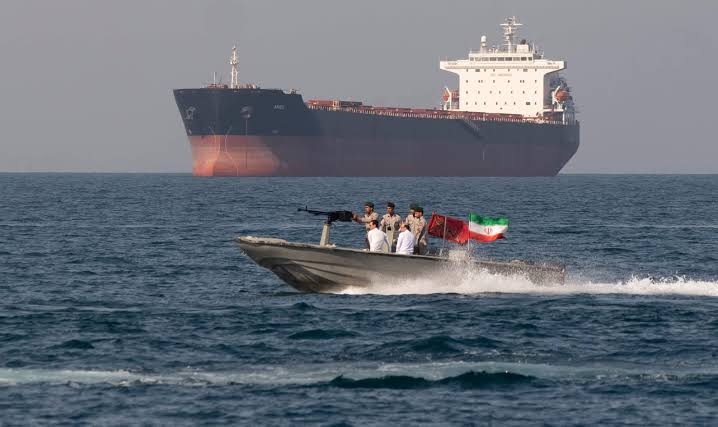
An oil tanker sails near an Iranian patrol boat in the Persian Gulf region. Photo: CNBC.
At the end of September, The Sacramento Bee documented that California drivers were paying about $6.39 a gallon for gas, within cents of the state record. The reason sits in a narrow strait 8,000 miles away.
But the war with Iran is doing more than raising prices at the pump. It is straining trade, heavily damaging U.S. military bases, and testing alliances, and it raises a question about a promise made at the start of President Trump’s second term: that a “golden age” of America was beginning. Does that promise hold up?
President Trump said in his January 2025 inaugural address at the Capitol that a golden age was starting. He has argued since that it has arrived, pointing to low unemployment and strong consumer spending, according to Bloomberg. The same reporting says inflation has been back above 3 percent since the war began in late February, with the war and the resulting energy shock as the main drivers.
The most direct way Americans feel the war is at the pump. The California Energy Commission says the war with Iran has restricted about a fifth of the world’s total crude oil supply, which normally flows through the Strait of Hormuz without major disruption. Iran has severely disrupted the Strait during this war as one of its most effective moves to pressure the US. Since oil is sold on a world market, a disruption in the Persian Gulf raises prices all throughout the world, despite the fact that California gets very little of its actual oil from the Middle East.
Diesel recently hit a record above $8 a gallon in California, according to the AAA. Costlier diesel raises the price of nearly everything moved by truck, train, or ship and shipping itself has become far more expensive. In mid-September, Bloomberg reported that hiring an oil tanker on the benchmark Persian Gulf route topped $1 million a day for the first time, roughly fifty times the prewar rate of $20,000 according to Gulf News.
Dr. Adil, a history teacher at Crystal Springs Uplands School, said the importance of narrow waterways like Hormuz is part of a much older pattern. “When commerce shifted away from land based trade to a lot more maritime trade,” she explained, there became “much more of an emphasis on having access to these … important points [and] choke points” in order to move goods. Those same routes, she said, can become “a risk to your own … national stability” when trade is disrupted.
The effects of this war reach far beyond drivers. The Economist stated that roughly 30 percent of the world’s fertilizer passed through Hormuz before the war, which can raise food costs more gradually over time. The Iran war isn’t the sole pressure. Tariffs imposed by the Trump administration also raise prices, and Bloomberg reports they already contribute to affordability problems.
Dr. Adil compared the current energy shock with historical parallels such as the 1973–74 Arab oil embargo, when restricted oil production during the Arab-Israeli War caused oil prices to rise dramatically. The crisis exposed “how much the West and, like, the US, Europe, all of these places were so dependent on imported oil.” She also pointed to the 1979 Iranian Revolution, when political upheaval disrupted Iranian oil production and exports. In that crisis, she said, “the fear of shortages was very great,” showing how expectations of scarcity can affect prices alongside actual shortages.
The war is also reshaping trade. Treasury Secretary Scott Bessent has threatened Turkey, a NATO member, with heavy tariffs if it continues to trade with Iran. A strike on an Egyptian port raised fears around the world that the war could potentially move closer to the Suez Canal, another crucial route for the world’s energy.
The American military has taken heavy blows as well. A congressionally mandated Pentagon inspector general report released in September found that Iranian strikes damaged and destroyed hundreds of buildings and structures at U.S. bases in eight Middle Eastern countries, and Pentagon officials are reportedly considering whether to close them permanently. The administration maintains their established position stating that Iran’s military has been majorly degraded, and a senior Pentagon official rejected the report’s suggestion that U.S. munitions are depleted.
Many U.S. allies have been reluctant to join the war. Trump’s push for an international naval force to secure safe passage through Hormuz fell apart quickly, and he directed his frustration at the countries that declined to cooperate. The spokesperson for the German chancellor said the war has nothing to do with NATO, and Spain was the only member to publicly deny the U.S. access to its bases and airspace for strikes on Iran. The picture isn’t one-sided, though: NATO Secretary General Mark Rutte said at least 22 countries joined an initiative, although nothing substantial has materialized at this point.
For students, the effects may extend beyond prices. Dr. Adil said consumers typically feel the effects of an energy shock first, particularly through rising gas prices. But she also emphasized the uncertainty created by an ongoing conflict. “There’s just a lack of sense of security with it,” she said. “There’s just a lot of ambiguity that keeps being produced.”
Energy Secretary Chris Wright, a supporter of American military action in the region, says the pain at the pump is temporary and necessary to destroy the “existential threat” of Iran. Trump and Bessent have said prices will fall once the war ends, and Trump has argued that the war will lower oil prices in the long run and that Americans should accept short-term pain to weaken Iran. Supporters also point to low unemployment and steady spending as proof the economy remains resilient despite the war’s costs.
Whether this era proves golden may depend on how the war ends and who ends up paying for it. For now, the bill arrives in small pieces like at the pump, the grocery store, and in the cost of moving goods. Supporters call this the price of a more secure world, and critics call it a war of choice that provides no direct benefit to Americans. Either way, students who can’t vote will inherit the result. A golden age is easy to declare, but the harder test is whether the people paying for it truly feel that way.



Leave a Reply