The billion dollar question as baseball heads into the offseason
By Alexander M. ‘29
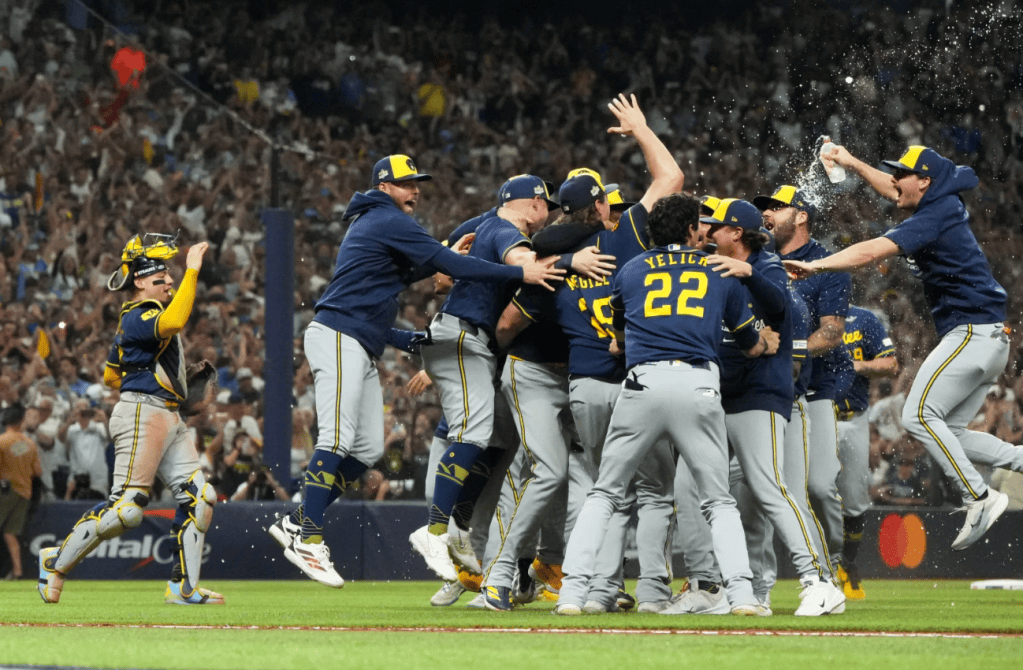
“The Brewers win the pennant. OH MY GOD! The Brewers win the pennant.”
Those were the words of radio broadcaster Jeff Levering when the Milwaukee Brewers defeated the Los Angeles Dodgers 6-4, completing a four-game sweep and winning the national league pennant for the first time in 44 years. The call paid homage to the late and iconic Brewers broadcaster Bob Uecker, who delivered a very similar line in his role of Harry Doyle in the classic sports comedy movie Major League.
But beyond all of the excitement, the Brewers’ postseason run represented something much bigger for Major League Baseball: a challenge to the idea that money yields success.
The Brewers, one of the league’s smaller-market organizations and ranked as the 12th lowest-spending on Yahoo Sports, entered the postseason as six to one underdogs, notably behind the Dodgers. Yet in almost every offensive category in their head-to-head matchup, the Brewers outshined the Dodgers’ star-studded lineup and limited them to only a single home run. This trend can also be seen on the other side of the league, where the Tampa Bay Rays, ranked as the 5th lowest-spending team, defeated the New York Yankees and would go on to face the Brewers in a “Small-market” World Series. This matchup marked a rare occurrence in MLB history, as both teams entered the Fall Classic chasing the first World Series win for their respective franchises.
While the Brewers and Rays provide compelling examples of smaller-market teams competing at the highest level, the opposite can also be true. Take the New York Mets, who entered the season with the second-highest payroll in baseball, but ultimately failed to make the postseason, despite having one of the most expensive rosters and spending over 300 million dollars. This proves that while money can certainly help a team acquire top-tier talent, it cannot guarantee wins. Player development, in-season trading, team chemistry and more than anything, execution can all play an equally important role in determining a team’s overall success.
However, the argument for a salary cap is not necessarily that the teams spending the most money will always win. Rather, it is about creating a more level playing field across all 30 organizations. And currently, the MLB operates quite differently from the other professional sports leagues in North America.
Unlike the NFL, NBA, and NHL, the MLB does not have a hard salary cap. Instead, the league operates under the Competitive Balance Tax (CBT), more commonly known as the luxury tax. Under this system, teams are allowed to spend as much as they want on player salaries, but organizations that exceed a predetermined threshold are required to pay additional taxes. Those penalties will increase for teams that repeatedly surpass the limit, discouraging organizations from maintaining high payrolls.
However, this system does not actually prevent teams from spending beyond the threshold. Wealthier organizations, such as the Dodgers, Mets, and Yankees, can continue pursuing expensive free agents in the offseason or trade deadline, as long as they are willing to pay the associated penalties. For smaller-market teams or organizations situated in cities that cannot generate the same amount of fan revenue as New York or Los Angeles, competing with high spending will be considerably more difficult.
This is where many MLB owners believe a salary cap could be beneficial. Mark Attanasio, owner of the Milwaukee Brewers, and a first-hand witness to their success, addressed the issue of competitive balance in an interview with CBS Sports.
“I think the fact that two teams like the Brewers and the Rays, we hear all the time that we play baseball the right way, that it’s exciting to watch…I think that’s good for baseball. So whatever that means relative to revenue systems or otherwise, I think if you have a more competitive set, you can have more exciting baseball.”
In this interview, Attanasio raises an important point about the salary cap debate, which is that competitive balance is not just about limiting how much the richest teams can spend, but also about giving every organization an equal opportunity to compete. More broadly, when smaller-market teams are able to challenge baseball powerhouses, it will create more interesting matchups and give all fans a reason to stay invested in their teams.
Under the current system, however, there is no guarantee that smaller-market organizations will receive the necessary financial support in order to do this. This has led MLB owners to advocate for a more nuanced solution, a system that contains both a salary cap and a minimum payroll floor. The distinction between the two is important, as a salary cap would establish a hard maximum amount that teams can spend on player salaries, while a salary floor would require every team to spend a minimum amount of money. Together, these two boundaries would theoretically narrow the financial gap between organizations at both ends of the spending spectrum.
In its latest proposal, MLB has suggested a salary cap of $258.2 million and a minimum payroll of $180.2 million, with the introduction date being set to the 2028 season. While the league argues that these limits would create a more competitive environment, the proposal has actually faced significant criticism from the MLB Players Association (MLBPA), which represents major league players.
Unlike the team owners, players have a financial incentive to maintain competition between organizations for their talent. And without a salary cap, teams with more resources can compete against each other to acquire the top free agents, often resulting in larger contracts for players. A salary cap would almost certainly limit this nature of competitive bidding and reduce overall player salaries across the league.
There is also the question of whether a salary cap would actually address the underlying causes for inequality. As briefly mentioned earlier, teams operate in markets with different populations, different television contracts, and different advertising opportunities. A team in New York or Los Angeles would naturally have access to a different financial environment than one in Cincinnati or Tampa Bay.
Ultimately, a salary cap could help address some of these problems, but it is not necessarily a complete solution. Financial resources will still allow teams to hold on to their best players and pursue new ones, but the 2026 postseason also demonstrated that spending is not the only factor that goes into being a successful team.
After all, some of the most exciting moments in sports history have come from major upsets, baseball included. The beauty of the game is in unpredictability, and that a team’s success should not be determined before the first pitch is even thrown. Fans should be able to go into every season believing their team has a chance, regardless of its market size or ownership wealth.



Leave a Reply