…
By: Vivaan K. ’29 & Owen Z. ’29

Fantasy football is a game that around 25 percent of Americans play every year. To some, it’s more than a game; they revolve their lives around it, spending hours each week checking their lineups, trying to make trades that will never happen, editing their teams, and listening to expert advice. While fantasy football is primarily meant to bring fun and competition, sometimes it can affect mental health in other ways.
Here, we have an interview with Lucas Li ‘29. Through this chat, we gain insight into the mind and perspective of an avid Fantasy participant and how they have been impacted. Lucas, who is currently in 6th place with a record of 2-2, said that he sometimes stays up at night thinking about fantasy football instead of doing his homework or studying. He explains that his focus on fantasy has had a negative impact on his grades and has led to increased levels of stress and anxiety during the season. We were also able to catch Lucas right after one of his most important players went out for the season; His response to this was that he felt consumed with depression, as he never thought something like this would happen to him.
As demonstrated in our interview, fantasy football has been taking a huge mental and physical toll on students’ lives, making them stay up late to think about strategy, or the genuine distress of finishing poorly in their fantasy endeavors. Now, you don’t have to just take our word for it: many studies have already proven what Lucas has conveyed. According to the American Heart Association, fantasy football has led to higher risk-taking rates, which ultimately causes both danger and anxiety for participants. Studies have also shown that losing weekly matchups takes a big toll on people’s mental health by negatively affecting their mood.
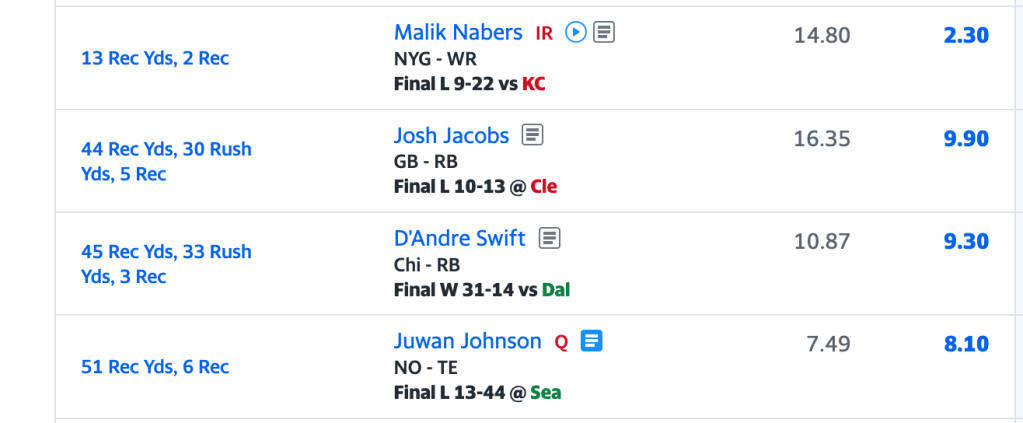
Here we have a team that scored under their projections.
However, Fantasy Football cannot be dismissed quite yet, as there is a simultaneous silver lining. Other studies from the American Heart Association have shown that fantasy football has led to greater connections between friends and family, and even long-distance relationships. It is one of the ways that people relax and build community all over the country.
If your fantasy team is not doing how you right now, don’t fret. Even if your team has spiraled into oblivion, just remember that it is just a game, and losing is not the end of the world. So, remember to stay positive even in tough times.
In conclusion, fantasy football affects people in more ways than they expect. For many, it can build friendship and keep them connected, but for others, it brings stress, anxiety, and even sleep loss. The interviews we conducted and research we found show that Fantasy football is not only a fun game played among friends, but a very real game that can potentially consume people’s lives.




 The Gryphon Gazette
Leave a comment