…
By: Annabelle S. ‘28
One of Crystal’s most notable alumni, Patty Hearst, became infamous after being kidnapped and indoctrinated by the Symbionese Liberation Army. She was born into the wealthy Hearst family, who built their fortune from the mining industry. She lived a life of wealth and security until February 4, 1974, when her name would be permanently etched into American History.
Early Life
Patty Hearst, born Patricia Campbell Hearst on February 20, 1954, is the granddaughter of American Publishing Magnate, William Randolph Hearst. Her family was extremely prominent and powerful, and she was heir to a large fortune. She attended private schools growing up, including Crystal Springs Uplands School, before enrolling at the University of California, Berkeley in 1973. As a sophomore studying art history and living with her fiancé, she had no bodyguards to ensure her safety—a decision her family would later come to deeply regret.
The Kidnapping
On February 4, 1974, at 9pm, there was a knock on Apartment #4 at 2603 Benvenue Street in Berkeley, California. A group of men and women with firearms drawn, grabbed the surprised 19 year old Patty Hearst, beat up her fiance, threw her in the trunk of the car, and drove off. It was later discovered, this group of merciless people was called the Symbionese Liberation Army or SLA. They were a smaller organization, but known for their violent ways. It was a group of young, mostly white radicals from middle-class backgrounds. Their leader, Donald DeFreeze, also the only African American member, was an escaped convict before he founded the SLA. The group wanted to incite a revolution against the US government and destroy the “capitalist” state. Her kidnapping immediately attracted national attention, not just because of the brutality of it but also because of her famous family’s prominence.
Soon after her disappearance, the SLA released audiotapes demanding millions of dollars in food donations in exchange for her release. As the money requested was extreme, her father only donated a few million dollars to a charity in San Francisco. However, this led to the charity distribution centers being overwhelmed and fights occurring. So, leaders of the SLA dismiss it as inadequate, and they continue to hold Patty. At the same time, they began to abuse and brainwash their captive. Hearst later described being threatened with violence, deprived of food and sleep, and subjected to psychological pressure. Over time, her captors gave her small privileges, from leaving the closet where she was confined to, to participating in discussions. Eventually, she was given an ultimatum: join the SLA or be killed. She decided to stay and fight alongside the SLA. Because of this, she began to receive daily lessons on weapons and was treated like any other member.
Bank Robbery
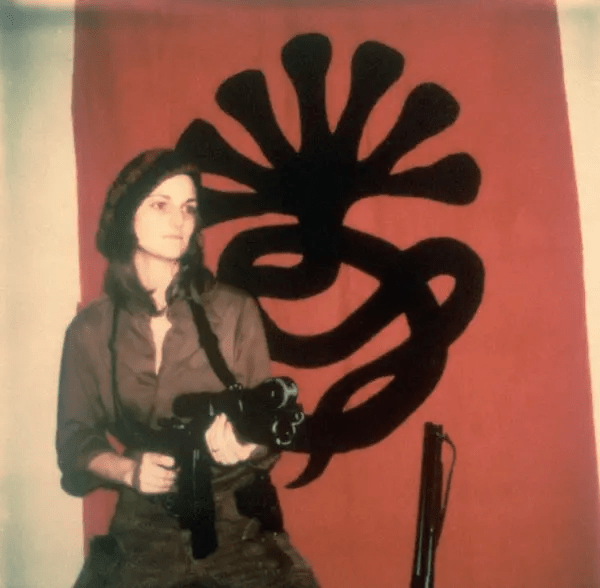
Propaganda used to signify Patty Hearst’s joining of their cause (Photo from the New York Times)
On April 3, the SLA released a tape of Hearst saying that she would join their fight to free the oppressed and had even taken on a new name, Tania. Patty later revealed that the SLA scripted these recordings and forced her to read them. The tape came with a photograph of her holding a submachine gun against the background of SLA’s emblem of a seven-headed cobra. This stunned not only her family but the whole world.
Soon after, on April 15, 1974, Hearst was seen on security cameras, carrying an M1 Carbine, while robbing the Hibernia Bank with three other SLA members in San Francisco. As she provided cover to her confederates, who shot two bystanders, she was seen barking orders to pedestrians to stay out of the way. The SLA members then fled in two cars, with over $10,000 in hand. This money would help fund their organization.
Aftermath
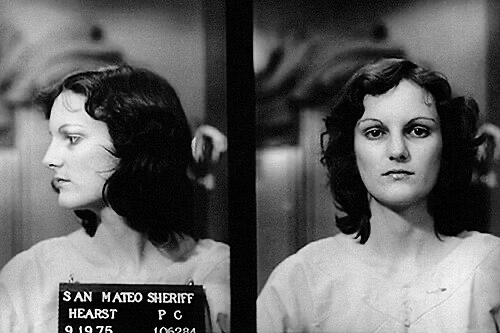
Patty Hearst’s Mugshot (Photo from CNN)
This event shocked the nation, and the FBI launched one of its most intensive manhunts to find Hearst and dismantle the SLA. Leads were scarce until May 16, when two SLA members were caught shoplifting in Los Angeles. Their getaway van led police to an SLA safe house, sparking a dramatic shootout the next day that ended in flames. Hearst and the Harrises, however, watched it unfold from a motel nearby. They laid low for a while, participating in only a few minor bank robberies throughout California.
The FBI finally caught up with Hearst after 18 months. They raided another San Francisco safe house where Hearst and the Harrises had been staying. She apparently had no resistance while being arrested and was unarmed. The safehouse contained guns, explosives, and revolutionary propaganda materials linking the group to robberies and bombings.
Trial
At her trial on March 17, 1976, Hearst was convicted of armed bank robbery and sentenced to seven years in prison. Many observers believed she was a victim of Stockholm Syndrome—a psychological condition in which hostages form bonds with their captors. After serving two years, President Jimmy Carter commuted her sentence, and in 2001, President Bill Clinton granted her a full pardon.
A New Life
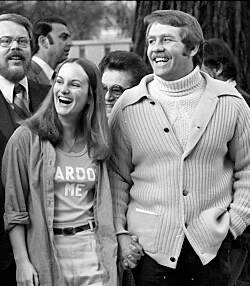
Patty Hearst and Bernard Shaw, her ex bodyguard and now husband. (Photo from Britannica)
Just months after her release, Hearst married her former bodyguard, Bernard Shaw. They had two children together. She later published an autobiography, Every Secret Thing, and appeared in several television and film projects. Today, Patty Hearst lives a quieter life in New York City, remembered both as a symbol of a turbulent era and as one of Crystal’s most extraordinary alumni.


 The Gryphon Gazette
Leave a comment