By Lachlan G. ‘24
Hi, my name is Lachlan and I am a senior at Crystal. I want to share a bit about my experience at this school for the past seven years in a completely honest way. I want to preface my article by saying I love Crystal. Some of the points I bring up are critical, but I still believe that this school is an amazing place and I would like to see it improve even after I have graduated.
The Good
1: Tight-knit, Caring Community
The best part of Crystal is that I know every single person in my grade and the vast majority of the student body. Although I’m an introvert, I can probably have a 5+ minute conversation with at least 90% of Crystal students. Chances are, I will likely share at least one extracurricular, interest, or class with that person. Whenever seats are randomly assigned in class, I am confident that the person I end up sitting next to will be a collaborative classmate and kind person. Since 6th grade, I’ve pretty much had the same friends that I always know I can count on for support, whether it is for English essay revisions or social advice. Another group I’ve particularly enjoyed knowing for a full 7 years is my French class of around 25 students. From creating our own French names with Mme. Dupeuble in 6th grade, to our trip to Quebec in 8th grade, to acting out scenes from Cyrano in 11th grade, I have so many fond memories of our class! I don’t think I could have had this small and intimate class group at many other high schools.
It might seem that our small size has some drawbacks. It is true that I see the same group of 20-30 people every day, especially in 11th and 12th grades, where increased class flexibility groups together students with similar academic interests. However, most people applying to and attending Crystal are comfortable settling into groups of similar-minded peers.
Additionally, all of my teachers who have taught me at Crystal have genuinely cared about me as a student as well as a person. Almost all of my teachers are willing to help me outside of class even before or after school and respond to emails quickly, even beyond school hours. Because of our small class size, Crystal teachers can give students plenty of individualized attention and learn more about the out-of-class interests of their students, allowing them to understand that you are more than just a student in their class.
Also, I appreciate the untraditional school spirit that bonds the Crystal community. Head of School Ms. Kelly Sortino put it perfectly: “Spirit doesn’t have to be this traditional view of Friday Night football games. But to me, one of the most spirited events that I’m part of is the Knowledge Bowl every year … Nothing makes me smile more than being up there and having a kid buzzing right away, get an answer and have the audience just erupt in applause. That’s spirit too. It just looks different.”
2: Wide Range of Extracurricular Activities
Crystal offers so many opportunities in terms of clubs, sports, academic competitions, and other extracurricular activities. Amazingly, we have over 90 clubs despite our small 350-student enrollment. Leadership positions are also plentiful at Crystal, and I would say that most students graduate with several leadership experiences. This is beneficial not only for college applications but also for the development of soft skills and character; being able to manage others, resolve conflict, and mentor younger students are invaluable skills that I have gained at Crystal.
3: Strong Academics
I believe that Crystal’s humanities courses are excellent, particularly in English. The close reading and analytical writing skills that I have honed at Crystal are some of the most useful tools this school has provided me with. Though I’m a STEM-leaning student, writing and communication are still crucial skills to fully realize the impact of science by sharing it with a broader audience. Crystal’s English classes require rigorous dissection of text which has taught me to notice subtleties that are easy to look over, a useful skill in a scientific career where every detail matters. Also, Crystal’s small class sizes allow for lively in-class discussions that have strengthened my critical thinking skills and ability to think on my feet. At the end of the day, we aren’t going to remember the majority of content we learn in class, but the habits we form and skills we acquire at Crystal will last long into our lives. Additionally, Crystal World Language and History classes have opened my eyes to not only global cultures but also different ways of thinking. Particular classes where I’ve grown the most as a student are (H) Math III with Dr. Parsons, (H) English IV with Ms. Tomatis, (H) Advanced Topics in Chemistry with Dr. Karraker, Modern European History with Mr. Bell, and (H) Data Analytics with Ms. Teter. As a STEM-leaning student, I would say the STEM offerings of Crystal are certainly robust, though maybe less so than classes in the humanities. For me, the most challenging part of STEM courses at Crystal are tests that require synthesizing knowledge across concepts and solving problems that you have not encountered in class but are equipped to solve. This has trained my problem-solving skills and ability to adapt on the fly.
The Bad
1: High Tuition
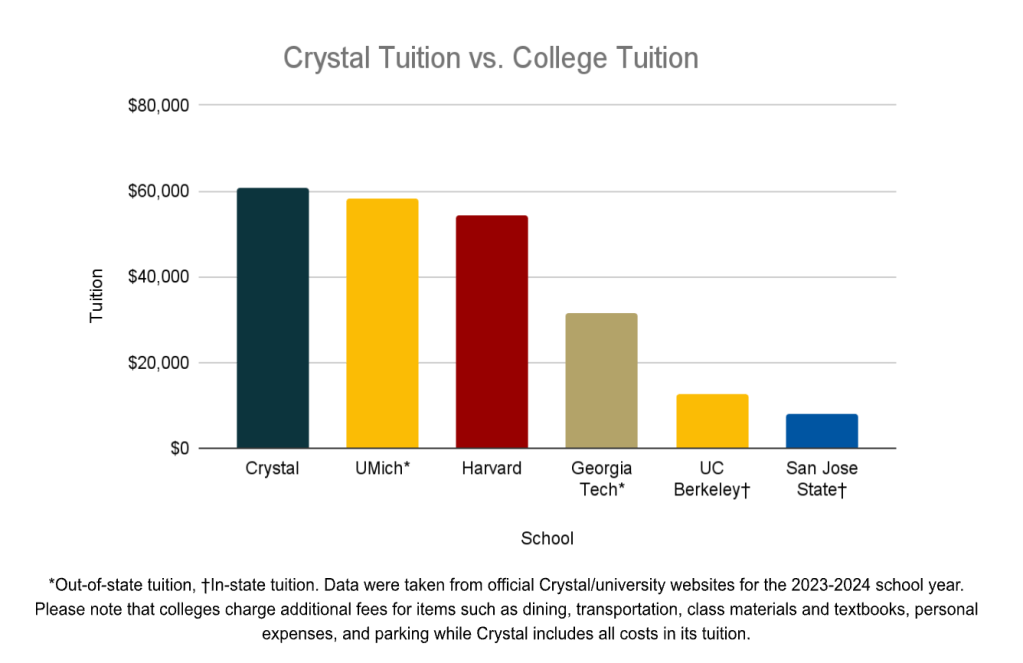
Crystal’s tuition for the 2023-2024 academic year is $60,850. This is $6,581 more than Harvard College and nearly 5 times as much as UC Berkeley, our state’s flagship institution and a world-renowned research university. Here’s a visualization of Crystal’s tuition compared to several colleges across the nation:
I wondered why the cost of a Crystal education is so high, so I sat down with Ms. Betsy Berman, Crystal’s Assistant Head for Advancement and Strategy, and Ms. Diane Isola, Crystal’s Chief Financial Officer, for an interview regarding tuition, budgeting, and finances at Crystal. Admittedly, I came into this conversation with some frustrations regarding budget allocation at Crystal, but after 45 minutes with Ms. Berman and Ms. Isola, my opinion shifted.
As Crystal is a private school that does not receive any government funding, costs will be high, but this is compounded by the fact that to attract faculty and staff, Crystal must offer competitive salaries for faculty who live in one of the most expensive regions of the world. Ms. Berman stated, “Our Board’s goal is for Crystal teacher salaries to be in the 90-95th percentile of our peer schools.” This is numerically reflected in Crystal’s expenses: 68% of tuition goes towards staff salaries. The remaining funds go toward financial aid (15%) and program, occupancy, and other expenses (17%). For comparison, the Nueva School spent 47% of its total expenses on “salaries, other compensation, and employee benefits,” while Menlo School was at 54% according to publicly available tax filings for the fiscal year ending in June 2022.

Statistics and Charts provided by Ms. Betsy Berman, Assistant Head for Advancement and Strategy.
When comparing Crystal’s overall tuition with our peer institutions such as Branson, Nueva, Urban San Francisco, Harker, Castilleja, Priory, Menlo, Lick Wilmerding, College Prep, and Sacred Heart, we are in the upper quartile.

Crystal’s high cost of tuition is largely due to our comparatively small endowment. Ms. Berman defined endowments as “funds that are invested over time to offer long-term financial security for schools like Crystal. Each year, schools use a portion of the income earned through the investment to supplement the operational budget. The larger the endowment, the more money is generated and can be used to support operations.” Crystal’s endowment is currently around $33 million while Nueva’s is $44 million, Castilleja’s is $53 million, Menlo’s is $88 million, and Sacred Heart’s is a whopping $109 million. A statistical analysis of endowment vs. tuition of Crystal and 10 other peer institutions generates an r-value of -0.6653, suggesting a strong negative correlation between these two factors. Put simply, a larger endowment means students usually pay a lower tuition.


Another factor contributing to Crystal’s high tuition is our small student population. Currently, Crystal’s upper-school enrollment is capped at 350 students by the Town of Hillsborough. With an increase of 100 students, there would be some additional expenses for things like hiring new teachers, but many expenses–facility maintenance, utilities, paying administrative staff, funding athletics, etc…–would largely remain the same. As Ms. Sortino put it, “ more revenue” generated by a larger student body would overall “help offset tuition so that we wouldn’t have to raise it as much.”
2: Overcommitted Student Body
Students at Crystal all seem to be doing a dozen different extracurriculars. This issue of overcommitment means that many student groups are filled with undedicated members. Some just aren’t interested in the activity and are only there so they can list it on their college applications, while others simply don’t have the time and energy to fully invest themselves in the work of the group or activity, wasting their time as well as the time of all of the other members of the group. As a club leader and sports team captain, I hate that half of my job is to try to convince people to come to our next club meeting or the day’s practice. I would much rather actually help others improve in their endeavors rather than convince them to show up. Furthermore, it seems that every new semester, I need to re-advertise my club and plead with others to join. Many student groups at Crystal experience similar experiences. While attendance and engagement in extracurriculars are challenges, the thing that I find most disheartening is when I hear a club member say, “I am quitting once I win something” or when I see a fellow senior leave their commitments right after their college applications are submitted.

Students are not completely at fault for this issue of overcommitment. Our relatively small population naturally means that in order to provide an extensive variety of extracurricular offerings, students often must make commitments to several activities. Ms Sortino stated, “We are significantly smaller than many of our peer schools…[but] families who choose Crystal want us to be able to compete in the same sports to have the same level of arts. To have a robotics team at the same level, to be able to have all the clubs.”
Exacerbating the issues of an overcommitted and undedicated general population, student leadership at Crystal is at times unprepared and ill-equipped. I believe that this stems from low requirements to become a leader at Crystal and poor leadership training. Ms. Sortino echoed the latter, saying “I don’t think we have done a great job of teaching students how to lead.” One group I have been a member of could benefit from using time in a more productive and meaningful fashion. In part, the large size of the group and number of leaders makes it hard to even take attendance in an efficient way, let alone to do the difficult work of cultivating trust and community in order to do activities or decide on projects that build affinity within the group and beyond.
3: Declining Academic Standards and Overemphasis on DEI and Community Building
I agree that diversity of race, culture, religion, socioeconomic status, gender, sexual orientation, ability, and more are all important to fostering a successful learning community at Crystal. However, I do not think the majority of Crystal’s DEI and community-building programming (community time, advisory activities, affinity spaces, DEI events, etc…) is meaningful, engaging, or creating tangible change. Sitting in the theater and listening to someone speak for an hour does not sufficiently engage Crystal with real-world issues. Rather, interactive activities such as assembling bagged lunches, researching the history of the Civil Rights Movement, and volunteering at local community organizations are much more meaningful and engaging. Since middle school, I do not think I participated in a single period of required programming that was entirely hands-on service learning.
Currently, our schedule has 2 hours and 55 minutes of required programming (advisory, 1-1s, community time, assembly, affinity spaces, class meeting/flex) each week. Across the 36 weeks of the school year, this amounts to over 105 hours. In my 7 years at Crystal, I’ve totaled 795 hours of required non-academic programming: 105 hours in 6th, 108 hours in 7th, 117 hours in 8th, 120 hours in 9th, 132 hours in 10th, 108 hours in 11th, and 105 hours in 12th. That’s a lot. Also, I feel that our required programming is quite repetitive. For instance, advisory seems to be the same thing every year: deep introspective reflection on who you are as a person and how you can help shape Crystal’s community. Of course, some programming is necessary such as assembly, but I think it is reasonable to cut down our programming time to around 60-90 minutes per week. Some people may say that we won’t have enough free time, but the 6 hours and 5 minutes per week of office hours, lunch, and breaks have not been accounted for in the required programming. Below are my calculations for hours of required programming in each grade.


Though increased DEI and community-building time may not necessarily be the direct cause of reduced classroom instruction minutes, there has at least been a correlation. Before COVID-19, we had seven class meetings every two weeks; now, we only have six. This might not seem significant, but over a 36-week school year, the new schedule reduces class time by over 108 hours across all classes. Our reduced class time combined with no homework weekends leaves teachers with a hard choice: either rush through lessons or cut content. I have heard many teachers, particularly in STEM, complain that our instruction time doesn’t allow for enough in-class practice and therefore increases the homework load. As a student, I feel that our reduced class time has decreased the amount of content I have learned as well as the quality of my learning.

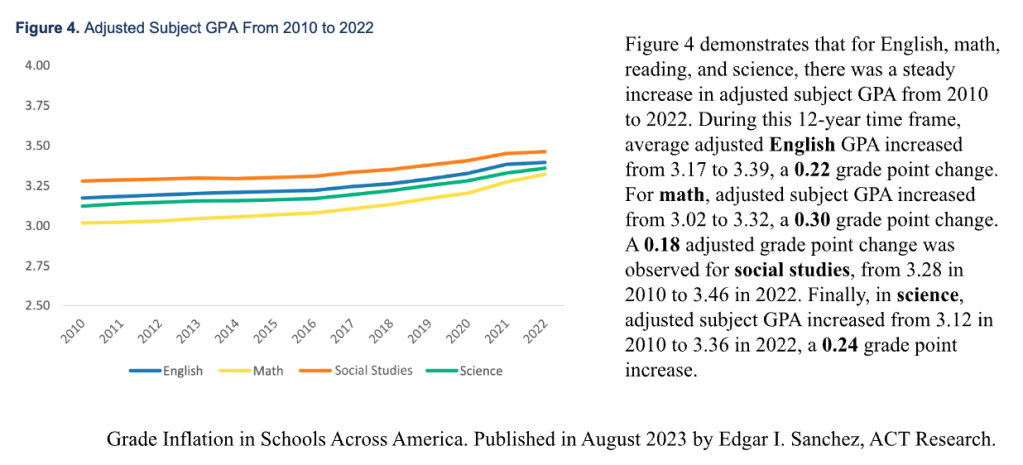
Like most other high schools in the United States, Crystal has also seen significant grade inflation and a lowering of academic standards over the years. There are many upper-level honors classes that I feel do not deserve the honors designation due to overly lenient grading policies such as full-point retakes/revisions, dropped/replaced tests, low workload, and unchallenging curriculum. Even in historically challenging courses, I’ve heard others say that the difficulty is decreasing. Ms. Sortino confirmed that Crystal has seen significant grade inflation, saying that the average GPA for the Class of 2016 was 3.72, while the average GPA for the Class of 2023 was 3.89. Despite this increase of 0.17 in GPA, the class of 2016 and 2023 had similar average ACT and SAT scores, indicating that grade inflation did not just occur because students became “smarter.”

One way to address grade inflation is to maintain consistent grading standards. For example, all honors classes could be mandated to maintain a class average of no more than 93%. At the same time, departments could agree upon reasonable leniencies such as dropping one quiz per semester and curving tests with an average score of below 87%.
One argument many people bring up to justify grade inflation is that it helps with college admissions since every school has experienced grade inflation. However, this argument is flawed because college admissions review applicants in the context of their high school. In other words, Crystal students are mainly compared against other Crystal students. This means that if everyone is receiving an A in a particular course, an A is not an impressive feat but rather the norm. Additionally, if an A is the norm, anything below that is a significant blemish on your transcript, further increasing stress around grades.
Also, some may say that classes do not need to cover that much content because we will not use most of the knowledge we learn in “real life.” However, challenging school work develops perseverance, work ethic, effective time management, successful studying habits, and many other soft skills. For example, in my opinion, (H) Math III is one of the hardest classes at Crystal, and although my grade was less than ideal, this was the class where I experienced the most growth as a student and person. Scoring sub-par on Dr. Parsons’ tests encouraged me to study harder and more, reduce wasted time procrastinating, reach out for help when necessary, and not settle for an inadequate understanding of class content.
Fundamentally, an A should represent true excellence, not mediocrity. To learn more about grade inflation as a nationwide issue, I recommend reading this New York Times article and this ACT research report.
Well, that’s The Good, The Bad, and The Ugly of my 7 years at Crystal! As I previously mentioned, I love Crystal as a school and community. However, I think there are significant issues at Crystal that we rarely publicly discuss and that need to be brought to light. Every single Crystal community member has a responsibility to uphold our core values and sometimes that means speaking up when we see what we perceive as wrong. I challenge everyone to reflect on and share their own positive and negative experiences at Crystal so far, whether it has been 7 months or 7 years. Expect a petition addressing issues raised in this article by early May. Thanks for reading!
Note: Please note that this version of my article has been significantly cut in order to make it more appropriate to be published for open web access. To access supplemental writing, figures and numbers, and full interview notes/recordings, please contact lguo24@crystal.org.




 The Gryphon Gazette
Leave a comment