By Alex L. ’27
In a world where borders often define our identities, there are individuals who defy such constraints, transcending geographical boundaries in their personal journeys. Vanno Noupech, United Nations High Commissioner for Refugees (UNHCR) representative to China, is one such individual. His life is a testament to the transformative power of migration, a story that transcends borders and challenges definitions.
Originally from Cambodia, Vanno Noupech wasn’t born knowing borders. His early years were marked by exposure to the world of international relations, primarily shaped by his father, a Cambodian diplomat. As he reflects on his upbringing, Noupech shares, “I was born in Cambodia, but I think I was less than three years old when I followed my father to France… my father joined the diplomatic service, so we moved from France to Egypt, Egypt to Chile.”

From sun-drenched France to bustling Egypt, from Andean peaks to the icy grip of Moscow, young Noupech had seen it all. Soon however, things would take a turn for the worst.
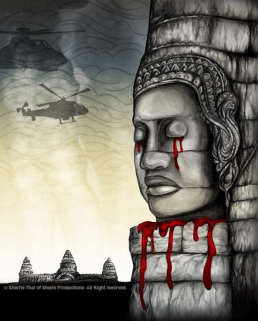
In 1979, a coup d’état in Cambodia forced the family back to their homeland, only to find it teetering on the precipice of the Khmer Rouge’s genocidal regime. At 14, Noupech became a reluctant participant in the brutal dance of conflict–now a refugee, adrift in a sea of displaced lives flowing towards the Thai border.
This wasn’t just a statistic; it was a raw, personal experience that etched itself onto his soul. Far from the exotic adventure of his early years; this was a stark lesson in the brutal reality of forced displacement, something he would hold on to.
As a result of the coup, he suddenly found himself serving as the attendant to one of the Khmer Rouge’s top officials, running errands, and fetching food. “They just asked me to join them. But I was not really given a choice,” Noupech emphasizes. “Fortunately, the commander changed sides, so he joined the Vietnamese army from the Khmer Rouge, and he took me with him.”
Yet, even in the darkest corners of life, hope flickered. A scholarship offer pulled him back to the former Soviet Union–a chance to rebuild his life, brick by painstaking brick. He chose engineering, a path laid out by the government, yet the yearning for diplomacy and understanding the human tapestry of nations burned bright within him. Getting the job, it turned out, was relatively easy; Noupech explains, “I already spoke some Russian. So when they sent me back to Russia I had, of course, some advantages compared to other students that were part of the group. I spoke French and Spanish already…which were not very widespread languages in Cambodia at the time.”
“But I was not really given a choice.”
Italy became his next port of call, a vibrant stage where he traded technical blueprints for the intricate maps of international relations. He studied diplomacy, inhaled the language of negotiation and cooperation, even spending two years in the private sector, before finally bringing his talents to the United Nations (UN).

Vanno Noupech at the UNHCR Azerbaijan Office in 1994.
He began his journey with the UN system in 1994 as a Junior Professional Officer for the UNHCR in Azerbaijan. In the role of Associate Field Officer, he shouldered the responsibility of managing a significant caseload of internally displaced persons during the first Nagorno-Karabakh War, an experience that would later shape his assignment in Chechnya. Over the course of his 28- year career, he diversified his roles, serving in various capacities with UNHCR in Rwanda, Bosnia and Herzegovina, and numerous other countries. Following his tenure as the UNHCR Representative in the Russian Federation, he assumed his current position and became a part of the UN family in China in August 2021.

Reflecting on his multifaceted experiences, he later recalls, “all of that—experience in the army at a young age, being the son of a diplomat traveling worldwide, private sector roles, and technical studies in Russia… these diverse experiences were assets to me. At some point, somehow, I knew what I wanted to do and sought to experience exposure to different languages, cultures, and conditions. This journey has played a significant role in shaping me into the person I am today.”
The UNHCR emerged as Noupech’s platform to enact change on a global scale. With a mission to address the pressing issues of forced displacement, Noupech embarked on a remarkable journey.
In the vast expanse of this humanitarian labyrinth, his diverse experiences became invaluable tools. Armed with firsthand understanding, Noupech confronted the fear reflected in a child soldier’s eyes, felt the silent desperation of families on the run, and witnessed the persistent yearning for home etched on the weathered faces of those caught in the throes of displacement. The statistics from the UNHCR itself tell a compelling story: by the end of 2023, a staggering 108 million people were forcibly displaced worldwide due to persecution, conflict, violence and human rights violations. This included over 29 million refugees and 62 million internally displaced persons, nearly 5 million more than the previous year. Yet, amidst these numbers, Noupech tirelessly navigated the complex terrain, striving to make a difference where it mattered most.
Today, as the UNHCR representative to China, Noupech leads the charge for millions uprooted by conflict and persecution. He speaks not just of statistics, but of stories, of lives intertwined, of resilience woven into the tapestry of human migration.

Vanno Noupech’s remarkable life journey serves as a poignant reminder that our shared humanity transcends geographical borders. From his early years as a diplomat’s son moving across continents, to being a refugee fleeing the Khmer Rouge’s brutal regime, to his illustrious career at the UNHCR, Noupech’s experiences have shaped him into a living embodiment of resilience and hope. His story challenges us to see migration not merely as statistics, but as a universal yearning for belonging that binds us all together. In a world where barriers seek to divide, Noupech stands as a testament to the transformative power of migration and the enduring spirit of the human experience that defies confinement.


 The Gryphon Gazette
Leave a comment