By Mihir J. ‘25 and Ollie B. ‘25
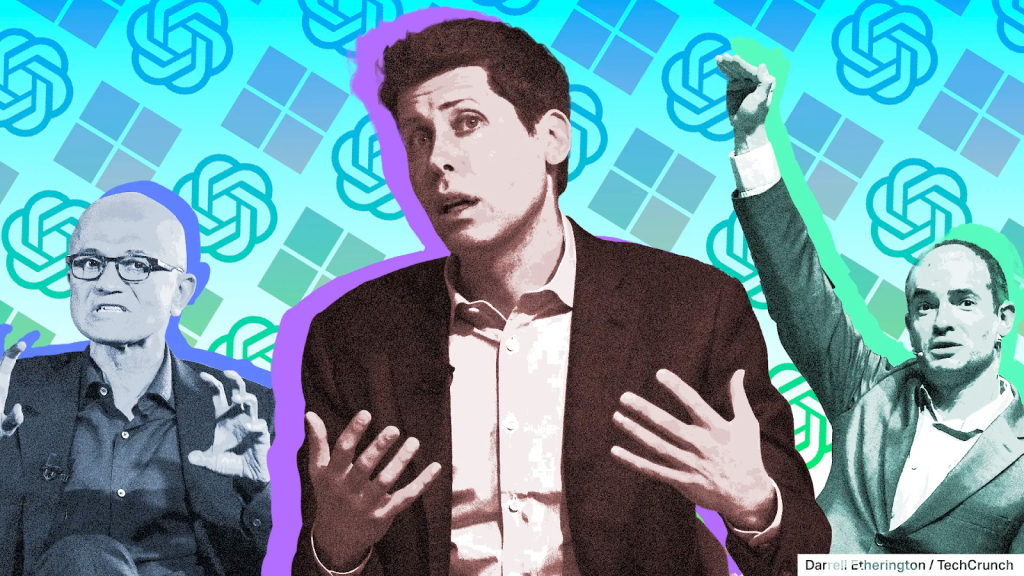
It was like an episode from the show “Succession.” On November 17th, OpenAI fired its CEO Sam Altman, but a mere week later, he was back at the company’s helm. With artificial intelligence becoming one of the fastest-growing industries worldwide, the decision to fire Altman came as a shock. Just a week before, the company appeared well-managed and ambitious for the future, announcing products like the GPT-4 turbo model during their DevDay. The company also flourished under Altman, with 92% of Fortune 500 companies using OpenAI products and ChatGPT having 100 million weekly users. So, with such success, why did the board try to oust one of the company’s core members? Most of it comes down to the company’s history and principles.
In 2015, OpenAI was founded as a non-profit research lab. Unlike many other tech companies, the company’s primary intention was not financial success but to develop tools that would “benefit humanity as a whole.” With investors like Elon Musk backing the company, such a goal was viable in OpenAI’s early years. However, just a few years later, Elon Musk cut ties with the company due to a fear of their commercialization, resulting in OpenAI losing a large source of financial support. This was especially devastating as the creation of artificial intelligence models needed abundant computing power, which meant generating financial resources was essential to the company. Therefore, OpenAI created a “capped profit” entity, where investors could make some profit while the remaining amount was reinvested into the company. However, despite these changes, the company’s initial executives focused on development instead of profit, and they were still prevalent and essential to OpenAI. Sam Altman, who was appointed CEO in 2019, had to ensure those initial principles remained truthful to the company. However, with the launch of ChatGPT, it seemed like the board of OpenAI believed Sam Altman steered too far away from the company’s original goal, leading them to fire him.
Ilya Sutskever, the chief scientist of OpenAI, led the effort to create new artificial intelligence models. From his perspective, AI poses a threat to humans in the future, so he believed the company should be more committed to AI safety. Sam Altman, while also recognizing the threats of AI, thought the company should prioritize expanding AI, which went against Sutskever’s beliefs and the company’s initial mission. Instead, the board believed Sam Altman wanted the commercialization of OpenAI products too quickly. For these reasons and their announcement that Altman “lack[ed] … transparency in his interactions with the board,” the board decided to fire him. The decision to oust Sam Altman was met with alarm from investors, shocked by the company’s sudden and drastic action. Microsoft, OpenAI’s biggest investor, decided to hire Sam Altman to lead a new advanced AI research team at Microsoft. Simultaneously, OpenAI was trying to find their new chief executive officer, appointing Mira Murati as interim CEO and then two days later appointed Emmett Shear, former executive of Twitch, as the next CEO.
However, just a day after Shear was appointed, 702 of 770 OpenAI employees had signed a letter pledging to move to Microsoft if Altman wasn’t reinstated as CEO and called for the resignation of all board members. By Tuesday evening, just a week after his firing, Altman made his return to OpenAI, alongside Greg Brockman, a board member who did not support Altman’s removal. The board underwent changes as well, with the addition of new members such as Bret Taylor, the former co-chief executive of Salesforce, and Lawrence Summers, a former Treasury secretary and Harvard professor.
The upheaval at OpenAI has highlighted a deep division within the field of AI. One faction advocates for a more cautious approach, emphasizing the potential threats of unregulated AI to society. On the other hand, Altman’s stance, shared by a significant portion of the industry, prioritizes the expansion of AI with proper management, believing in its potential to bring about life-changing enhancements.
As the dust settles, the future of OpenAI remains uncertain, with questions lingering about how the company will navigate this division and what direction it will take in the evolving landscape of artificial intelligence. The events following Altman’s reinstatement underscore the challenges and debates surrounding the responsible development and deployment of AI technologies.


 The Gryphon Gazette
Leave a comment